 Albania
 Argentina
 Australia
 Austria
 Belgium
 Bosnia and Herzegovina
 Brazil
 Bulgaria
 Canada
 Chile
Chile
 Colombia
 Croatia
 Czech Republic
 Denmark
 Estonia
 Finland
 France
 Germany
 Greece
 Hungary
 Ireland
 Italy
Italy
 Latvia
 Lithuania
 Luxembourg
 Mexico
 Moldova
 Montenegro
 Netherlands
 New Zealand
 North Macedonia
 Norway
 Philippines
 Poland
 Portugal
 Romania
 Serbia
 Slovakia
 Slovenia
 South Africa
 Spain
Spain
 Sweden
 Switzerland
 Turkey
 Ukraine
 United Kingdom
 United States of America



Strings for Basses | page 6
Bass guitar strings determine the resistance under your fingers, the response to each attack and the character of the tone. Before buying, check the number of strings, scale length, mounting method and tuning of the instrument. Then compare the gauge, material, winding type and any surface coating. The set must fit the bass guitar in terms of dimensions; a “light” or “medium” label alone is not enough to make a safe choice.
Start with string count and scale length
A standard four-string bass guitar needs a 4-string set. An instrument with an added low string requires 5-string bass strings, while a six-string model needs a 6-string set. Multi-string sets are available for other configurations. The number of strings is only the first step: compare their dimensions and tuning as well.
Scale length determines how long the speaking and winding sections of a string need to be. Short, long and extra-long scale strings are not interchangeable based on gauge alone. Measure the instrument according to the manufacturer's instructions and check where the winding reaches the nut and tuning machine. Strings routed through the body may require a greater overall length.
Gauge and tuning
A lighter set generally offers less resistance and can make fast playing or bending notes easier. A heavier set feels firmer and may help with lower tunings, but it also puts more strain on your fingers and the instrument. If you make a substantial change in gauge, check the width of the nut slots, the action and the intonation. If a string binds in its slot or sits too loosely, the appropriate solution should be left to a repair technician.
| Choice | Typical feel | What to check |
|---|---|---|
| Lighter set | More flexible when fretting and playing with a dynamic attack | Whether the strings hit the frets during forceful playing |
| Medium set | Balanced resistance for a range of styles | The scale length and dimensions recommended by the manufacturer |
| Heavier set | Greater resistance and tension | Lower tuning, the nut and a new instrument setup |
Roundwound or flatwound
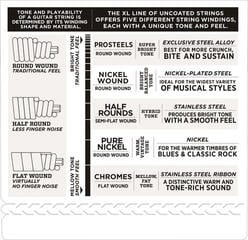
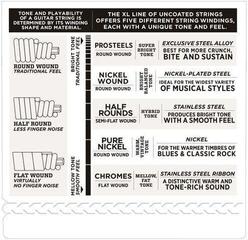
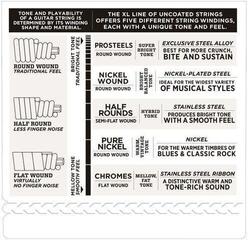
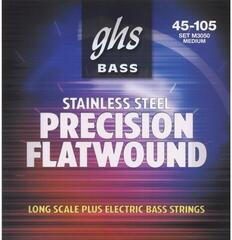
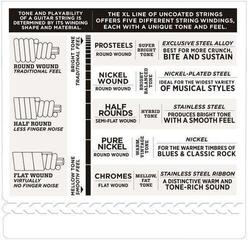
Roundwound strings have a round outer winding, a more pronounced texture and usually a clearer metallic attack. Flatwound strings have a smoother surface and a softer feel; they are often chosen for a smoother tone and less finger noise when moving along the strings. If that is the feel you want, explore flatwound bass strings. Neither type is universally better — the choice depends on your style, amplification and the instrument's response.
Material and coating
Bass string sets may use nickel-plated or steel windings, for example. The material affects the feel, magnetic response and tone, but the result also varies with the pickups, amplification and playing technique. Coated strings may resist sweat and dirt more effectively, although some players notice a different texture. Compare the manufacturer's specific information and wipe the strings with a dry cloth after playing.
Electric and acoustic bass guitar
For an acoustic bass instrument, choose from the acoustic bass guitar strings category. Their construction is designed for a different method of producing sound than the magnetic pickups of an electric bass guitar. Do not choose them solely by the number of strings; check the scale length, bridge and the instrument manufacturer's recommendation.
A full set or a single string?
If a newly fitted string is damaged, a matching gauge from the range of single bass guitar strings may help. If the other strings are older, dirty or uneven in tone, the new individual string may stand out noticeably among them. In that case, replace the entire set and make a note of its gauges; your next purchase will be easier.
You can find instructions for safe replacement and subsequent tuning in the article How to change bass guitar strings.
Deals & Coupons: Strings for Basses
Bundles: Strings for Basses

4 String Sets for Electric Bass
5 String Sets for Electric Bass

6 String Sets for Electric Bass
Miscellaneous Stringsets for Electric Bass

Acoustic Bass Guitar Strings

Single Strings for Bass

Flatwound Bass Strings
Coupon 15: Strings for Basses
Coupon 10: Strings for Basses