 Albania
 Argentina
 Australia
 Austria
 Belgium
 Bosnia and Herzegovina
 Brazil
 Bulgaria
 Canada
 Chile
Chile
 Colombia
 Croatia
 Czech Republic
 Denmark
 Estonia
 Finland
 France
 Germany
 Greece
 Hungary
 Ireland
 Italy
Italy
 Latvia
 Lithuania
 Luxembourg
 Mexico
 Moldova
 Montenegro
 Netherlands
 New Zealand
 North Macedonia
 Norway
 Philippines
 Poland
 Portugal
 Romania
 Serbia
 Slovakia
 Slovenia
 South Africa
 Spain
Spain
 Sweden
 Switzerland
 Turkey
 Ukraine
 United Kingdom
 United States of America



How to read sheet music
Sheet music looks like a secret code, but you can learn it in one afternoon. We'll show you how to read music from scratch: the staff, the clefs, note names and how long each note lasts. No dull theory, just what you really need for your first song.
What is sheet music and why bother?
Sheet music is written-down music. It tells you two things: which note to play and how long it should sound. Once you can read it, you can play a song you've never heard and talk to any musician in the world. It works like an alphabet. A few basic rules and the rest comes while you play.
Good news to start with: for your first song you only need to understand the staff, the note names and their length. You can do that today.
Can you learn to play without reading music?
Yes, you can. Many guitarists and singers play from chords, tabs or by ear. But sheet music gives you precision and opens up a whole world of pieces, from classical to film scores. If you play piano, violin or a wind instrument, sheet music will pay off sooner or later. Treat it as a bonus skill, not a barrier before your first note.
The staff and the clef: where notes live
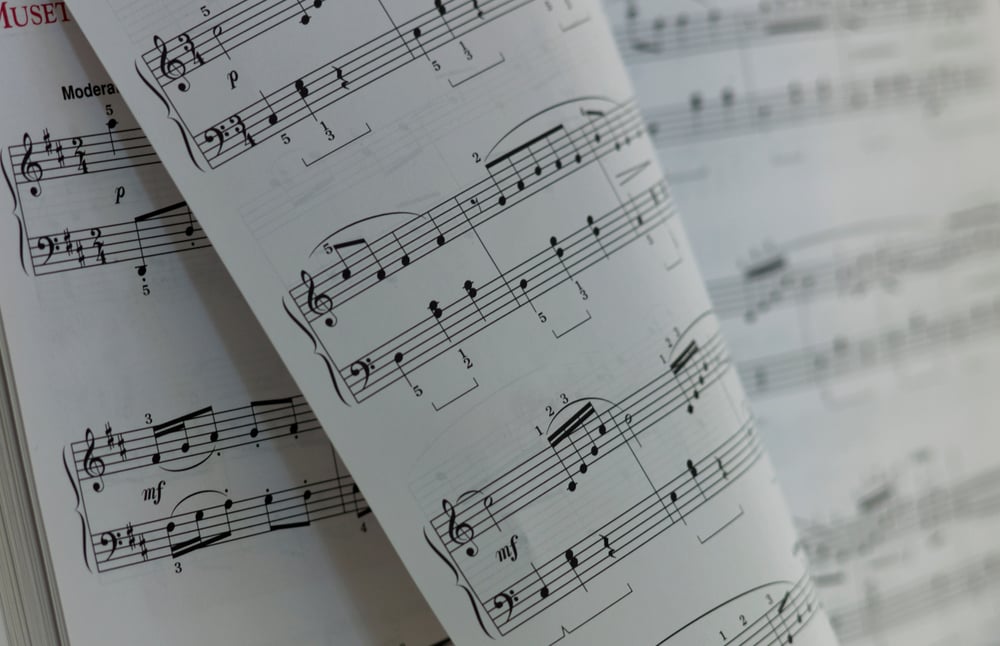
The staff is five horizontal lines with four spaces between them. Notes sit either on a line or in a space. The higher a note sits on the staff, the higher it sounds. At the start of every staff there is a clef, which tells you how to read the lines.
What is the treble and the bass clef?
The treble clef (G clef) is used for higher notes: the right hand on the piano, the guitar, the violin, the flute, singing. The bass clef (F clef) writes lower notes: the left hand on the piano, the bass guitar, the cello. On the piano you read both at once, because the notes sit on two staves above each other. Between them lies middle C, the link between both clefs.
What are the notes called and where do you find them?
Notes have seven names: C, D, E, F, G, A, B. After B the cycle repeats from C, an octave higher. In the treble clef the five lines from bottom to top are E, G, B, D, F. The four spaces from bottom to top spell F, A, C, E. Once you memorise these nine positions, you can read the vast majority of notes.
How do I memorise the notes on the lines quickly?
Use a simple memory trick. The lines E, G, B, D, F give the sentence „Every Good Boy Does Fine“, and the spaces spell the word FACE. You don't need to recite them backwards. Just find one fixed point, such as middle C, and count up or down from there.
Note values: how long does each note sound?
The shape of a note tells you how long to hold it. A whole note is an empty oval and lasts four beats. A half note has a stem and lasts two beats. A quarter note is filled in and lasts one beat. An eighth note has a flag and lasts half a beat. A sixteenth note has two flags and lasts a quarter of a beat. Each smaller value is half of the one before it.
Silence has its own notation too. It's called a rest and has the same lengths as notes, except you stay quiet instead of playing.
What is a bar and a barline?
The bar is the basic unit of rhythm. Vertical barlines divide a piece into equally long sections. The numbers at the start, for example 4/4, tell you how many beats are in a bar and which kind. A 4/4 bar means four quarter beats. That's exactly why you know where to clap the steady pulse in a song.
Accidentals and other signs you'll see
Besides notes and rests you'll meet a few signs that change the pitch or the way a note is played. A sharp (#) raises a note by a semitone, a flat (b) lowers it by a semitone, and a natural cancels a previous accidental. A dot after a note extends its length by half. A slur between notes (legato) means a smooth connection and ties the tones into one breath.
You don't need to learn them all at once. You'll get to know them gradually in the pieces you play.
How does notation differ by instrument?
The principle is the same everywhere, only the clef and the way technique is written change. The piano and the keyboard use two clefs at once for both hands. Guitarists often read tabs as well as notes, a simplified notation that shows the finger and the fret. Drummers have notes on a staff where each position marks a different drum or cymbal.
Are tabs the same as sheet music?
No. A tab shows where to put your fingers on the guitar fretboard, but it does not give the exact length of a note. Sheet music gives both pitch and length, but will not tell you the specific fret. Ideally you know both. A tab helps you learn a song fast, sheet music helps you master a piece precisely. There is more in our guide how to learn guitar.
How to learn to read music fast? 5 steps
Reading music is about repetition, not talent. Stick to a simple plan and results come in a few weeks.
First, learn the notes in the treble clef. Second, match them to your instrument, that is find C, D, E on the keys or on the strings of a guitar. Third, practise slowly with a metronome and a tuner at hand. Fourth, play short songs you already know, such as Für Elise. Fifth, read music every day for at least ten minutes. Short and regular beats two hours once a week.
Can you learn an instrument without knowing how to read music?
Yes. On the guitar and in singing a lot is played from chords and by ear. But on the piano, the violin and wind instruments sheet music pays off. We see it as a skill that opens up more pieces for you.
What's the fastest way to memorise the notes on the staff?
Learn one fixed point, such as middle C, and count from there. Use a sentence for the lines and a word for the spaces. Most of all, a short daily exercise with real songs helps.
What's the difference between a note and a chord?
A note is a single tone. A chord is several tones played at once, usually three or more. In notation you see a chord as notes stacked above each other in one vertical line.
How long does it take to learn to read music?
You'll get the basics in one afternoon. Fluent sight-reading comes after a few months of regular playing. The pace depends on how often you practise, not on your age.
Are notes the same for piano and guitar?
The notes are the same, the clef and the way technique is written differ. The piano uses both the treble and the bass clef at once, the guitar mostly the treble clef and often tabs as well.
Get playing
Now you can read the staff, name the notes and work out their length. That's all you need for your first song. Pick an instrument and start. If you're still deciding what to go for, our guides how to learn piano, how to learn guitar or how to learn drums will help. You'll find instruments and accessories in the categories digital pianos, keyboards, acoustic guitars and electric guitars.