Albania
 Argentina
 Australia
 Austria
 Belgium
 Bosnia and Herzegovina
 Brazil
 Bulgaria
 Canada
 Chile
 Colombia
 Croatia
 Czech Republic
 Denmark
 Estonia
 Finland
 France
 Germany
 Greece
 Hungary
 Ireland
 Italy
 Latvia
 Lithuania
 Luxembourg
 Mexico
 Moldova
 Montenegro
 Netherlands
 New Zealand
 North Macedonia
 Norway
 Philippines
 Poland
 Portugal
 Romania
 Serbia
 Slovakia
 Slovenia
 South Africa
 Spain
 Sweden
 Switzerland
 Turkey
 Ukraine
 United Kingdom
 United States of America






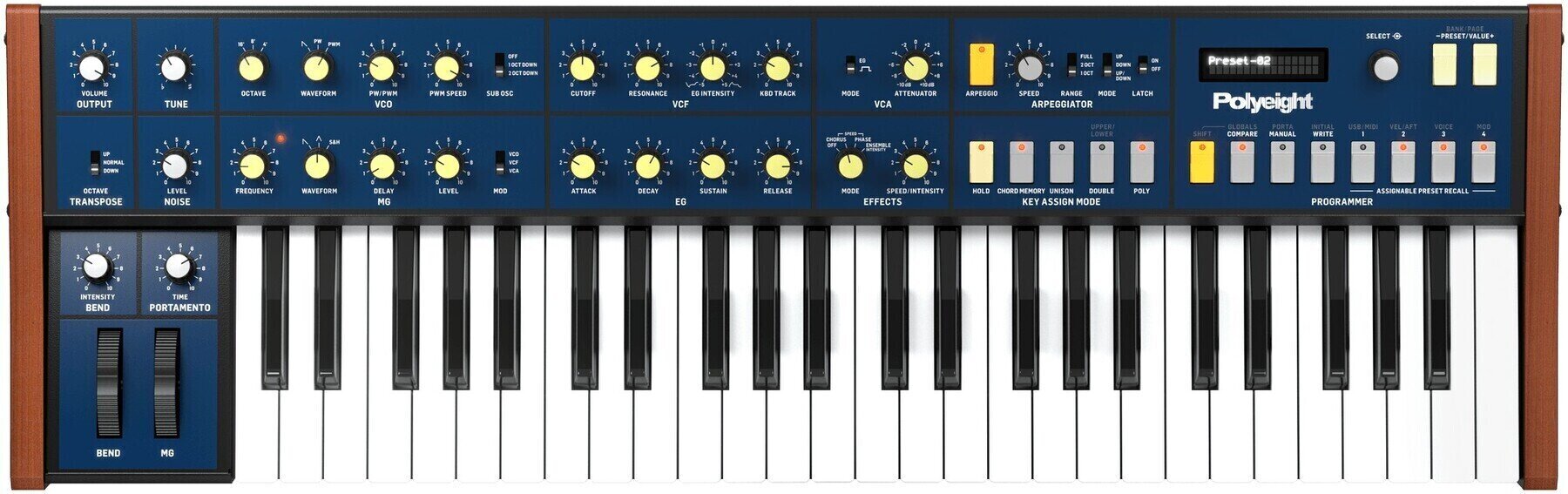
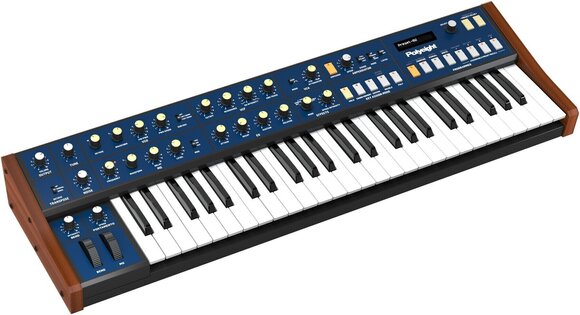
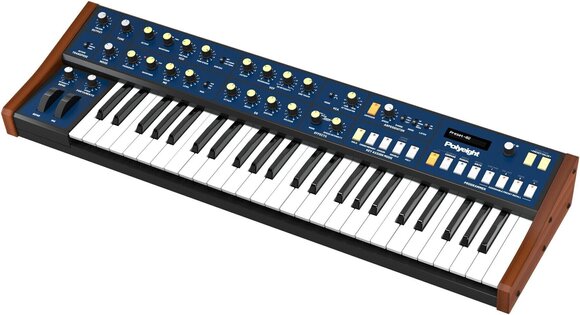

- Type: Analog, Keyboard Synthesizer, Polyphonic Synthesizer
- Sound Engine: Analog
- Number of Keys: 49
- Keyboard Type: Polyphonic Aftertouch
- Polyphony: 8
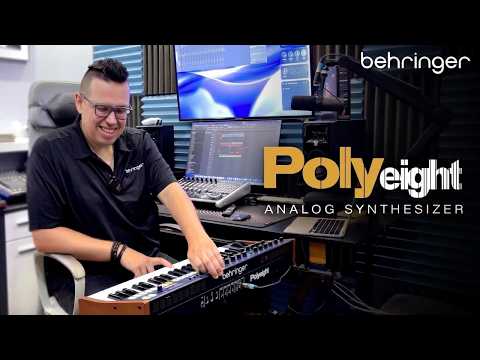
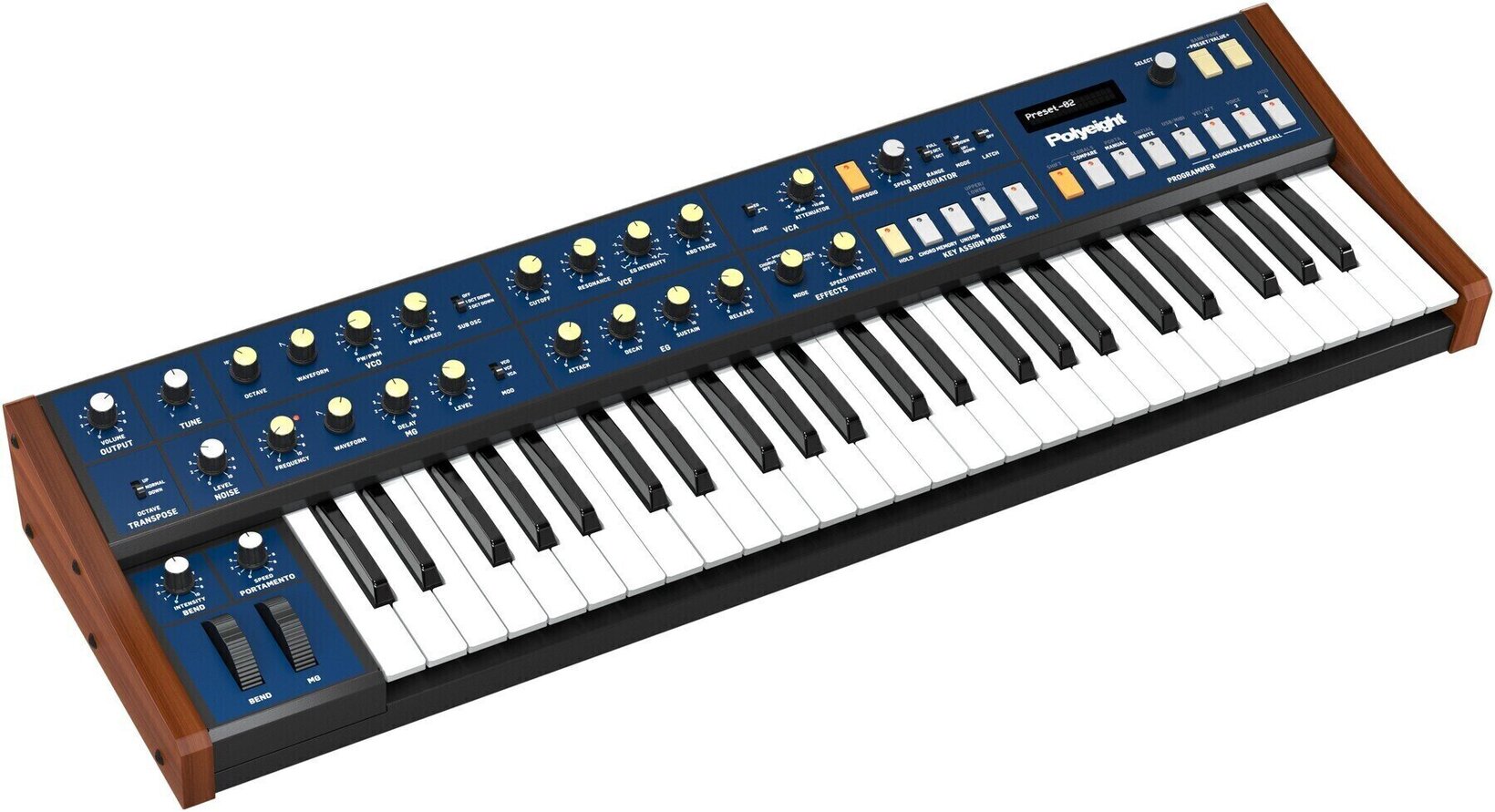
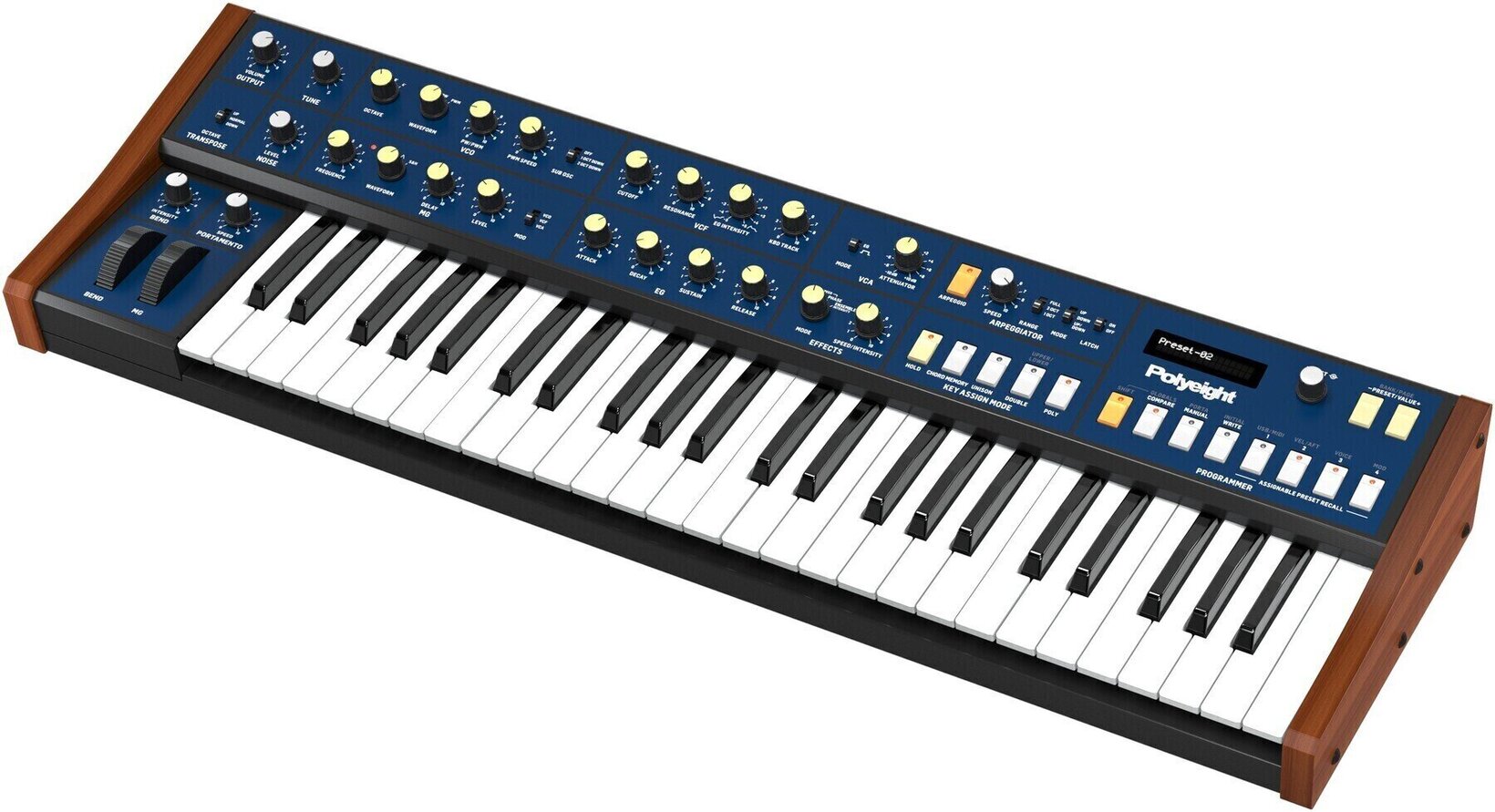
Behringer Polyeight Synthesizer
This analog 8-voice programmable polyphonic synthesizer is inspired by the classic Korg Polysix. Built around discrete VCOs and the classic 2044 lowpass filter, it delivers warm saw, square, and pulse-width tones across unison, double, and poly modes. A 49-key semi-weighted keybed with channel aftertouch, an eight-slot modulation matrix, and onboard BBD chorus/phaser/ensemble effects make it a complete production instrument.
- 8-voice polyphony with discrete analog VCOs and the classic 2044 lowpass filter
- 49-key semi-weighted keybed with channel aftertouch and velocity sensitivity
- Multi-stage chorus, phaser, and ensemble BBD effects built into the signal path
- 256 user program memories, advanced arpeggiator, and full MIDI integration
Behringer Polyeight — Eight Voices of Korg Polysix Magic
The Behringer Polyeight is an analog 8-voice programmable polyphonic synthesizer inspired by the classic Korg Polysix. Built around warm-sounding discrete VCOs and the unmistakable 2044 lowpass filter, this instrument delivers lush, characterful polysynth textures. Each voice carries saw, square, and pulse-width waveforms, while the 2044 filter offers resonance and positive/negative envelope control for everything from glassy pads to gritty leads.
Switching between unison, double, and poly modes unlocks thick 8-VCO lead sounds, massive bass, and 8-voice single-VCO textures. Onboard multi-stage chorus, phaser, and ensemble BBD effects sit inside the signal path, delivering rich movement.
What Sets This Synth Apart
Two features distinguish this model from typical polysynth recreations. The eight-slot modulation matrix lets players route the multi-waveform LFO, envelope generators, and other modulation sources to nearly any destination, opening up complex evolving textures. Polyphonic portamento and chord memory allow a single key to trigger full saved chord progressions with smooth musical glides between voices — transforming the instrument into a performance-driven tool.
Analog Voice Architecture and Filter Design
The voice architecture is rooted in fully analog circuitry, with each of the eight voices running its own discrete VCO. This preserves the slight voice-to-voice detuning and harmonic richness that define classic polysynth character.
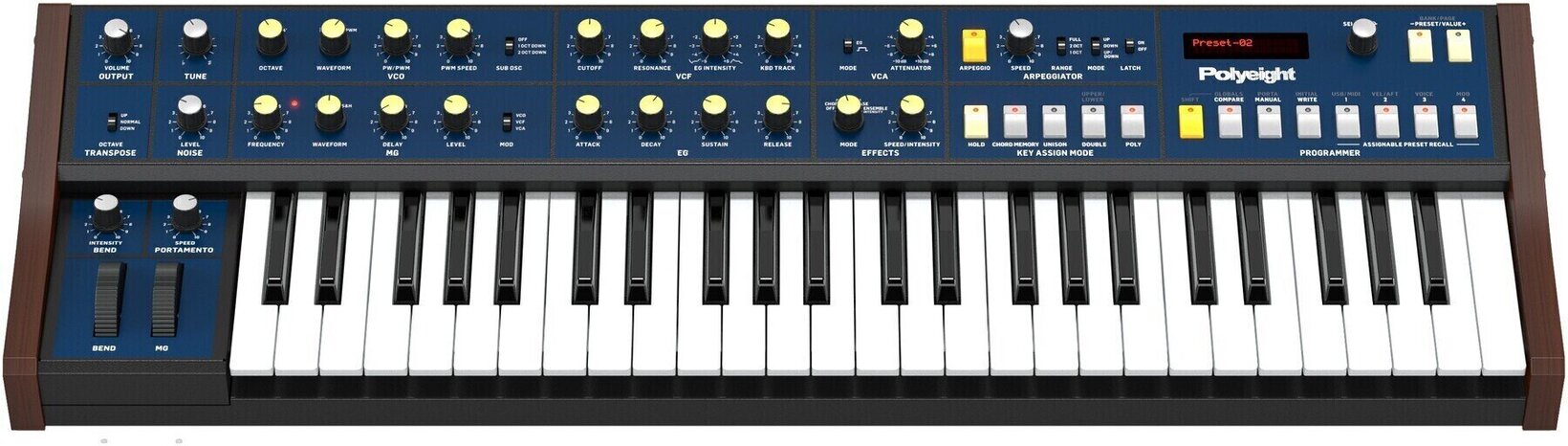
- Oscillators: Analog VCOs (8 voices, discrete design) — saw, square, and pulse-width waveforms per voice
- Filter: Classic 2044 lowpass with resonance and positive/negative envelope control — the defining tonal signature of the Polysix lineage
- Sub-Oscillator: Switchable to 1 or 2 octaves below — adds powerful depth and bass weight to any patch
Keyboard, Aftertouch, and Modulation Power
Expression comes from a serious player's keybed and a deep modulation toolkit. The 49-key semi-weighted full-size keyboard responds to velocity and channel aftertouch across every voice, while the modulation matrix and multi-waveform LFO give sound designers precise control over pitch, filter cutoff, and loudness.
- Keys: 49 semi-weighted full-size keys — velocity-sensitive with channel aftertouch
- Polyphony: 8 voices — switchable across unison, double, and poly modes
- LFO: 1 multi-waveform LFO — routable through the 8-slot modulation matrix
- Envelope: ADSR — with positive/negative filter envelope control
Arpeggiator, Memory, and Studio Integration
This synth ships with everything needed for stage and studio use, from a sophisticated arpeggiator to comprehensive MIDI connectivity. Patch management is fast thanks to the LCD with encoder and 256 user program memories, while the compare-and-match feature lets players quickly align all analog controls to stored patch values.
- Arpeggiator: Up, down, and up-down modes with manual and external tempo control
- Memory: 256 user program memories with compare-and-match
- Connectivity: Full MIDI, sustain/expression pedal inputs, polyphonic portamento, chord memory
- Effects: Multi-stage chorus, phaser, and ensemble BBD — built into the signal path
Who Should Consider the Polyeight
This synthesizer is the right choice for synth players and producers who want authentic analog polyphony with modern performance features at an accessible price. It suits studio producers working on synthwave, Italo disco, new wave, and pop productions who need lush chorused pads, thick unison leads, and punchy analog basses. Live performers benefit from channel aftertouch, the expressive keybed, and the arpeggiator for hands-on stage use.
Sound designers will appreciate the eight-slot modulation matrix, sub-oscillator, MS-20-inspired noise generator, and pulse-width modulation for crafting complex evolving textures.
Number of Keys: 49
This instrument has 49 keys, equivalent to 4 octaves, providing a wide range of tones for a variety of musical applications.
Aftertouch: Yes
Aftertouch technology on the keys allows musicians to add a new level of expression to their playing. When a key reaches the bottom of its stroke, the pressure exerted on the key can continue to be sensed and used to control various aspects of the sound, such as vibrato, volume, or tone modulation.
Polyphony: 8
The polyphony of this instrument allows up to <%=tp_value % notes to be played simultaneously, providing rich and complex musical possibilities.

LFO: 1
An LFO, or low frequency oscillator, brings electronic sound to life. It adds movement and interest to synthetic sounds and effects, playing an important role in both subtle synthesis and bold sound design. However, you won't hear the LFO itself because it acts as a modulator. This means that it does not directly affect the audio signal, but adjusts other parameters such as oscillator pitch and filter clipping.
Envelope: ADSR
The ADSR (Attack, Decay, Sustain, Release) type envelope filter gives you precise control over the dynamics and shape of your sound. The ADSR components are detailed as follows: Attack: Specifies how quickly the sound reaches its maximum volume upon activation. Decay: Specifies the time it takes for the volume to drop from maximum to sustain. Sustain: Represents a stable volume level that is maintained as long as the sound is active. Release: Specifies how quickly the volume fades to zero after the sound has been released.
Pitch Bend: Yes
The Pitch Bend allows smooth pitch changes, adding expressiveness to musical expression. Often used to create effects such as glissando or vibrato, this feature allows the player to make subtle or dramatic changes to the sound in real time. Pitch bend allows musicians to create smooth transitions between notes, increasing the dynamics and expressiveness of their performances.
Modulation: Yes
Modulation allows you to change different aspects of the sound in real time, opening up a wide range of creative possibilities. For example, it can affect the pitch of the sound, creating a vibrato effect, or it can change the amplitude of the signal, creating a tremolo effect. It can also adjust filtering to create smooth transitions between frequency bands and dynamic textures. Modulation can also be used to change the character of the sound depending on the time or intensity of playing, giving the sound a lively and moving character.
Arpeggiator: Yes
The Arpeggiator transforms chords into sequences of individual notes played in various rhythmic and melodic patterns. Instead of playing the chords as a harmonic whole, the Arpeggiator breaks the chords into individual notes and plays them sequentially according to the selected algorithm.
Effect Types
- Phaser
- Chorus
- Ensemble
Headphone Output: Yes
The headphone output allows direct connection of headphones for private listening. This output provides a convenient way to enjoy the sound without disturbing others or ambient noise.
Inputs
- Jack 6,3 mm TS
- USB B
- MIDI IN
Outputs
- MIDI Thru
- MIDI OUT
- Jack 6,3 mm TRS
- Headphone Jack 6,3 mm
Pedal Inputs
- Expression
- Sustain
MIDI Interface: Yes
It supports MIDI, allowing you to connect and communicate with other MIDI-compatible devices. This feature extends control and integration into the larger music environment, increasing flexibility and creativity in music creation.

Type
Analog, Keyboard Synthesizer, Polyphonic Synthesizer
Aftertouch
LFO
Envelope
ADSR
Oscillators
Modulation
Arpeggiator
MIDI Interface
Touch Sensitive
Sound Engine
Number of Keys
Keyboard Type
Polyphonic Aftertouch
Key Size
Full Size
Polyphony
Pitch Bend
Yes
Display
Display Type
Power (Watt)
Headphone Output
Inputs
Outputs
Pedal Inputs
Analogue Outputs
USB
USB MIDI
USB to Host
Filter
Low Pass, Resonance
UK/EU Power supply included
Width (cm)
82,5
Height (cm)
12
Depth (cm)
26
Weight
7,5 kg
Net Weight (kg)
7,5
Made in
China


Documents
Instructions for use
Manufacturer information
Safety instructions
Please refer to the user manual for the specific safety instructions for this product.